The Sharks of the Red Sea
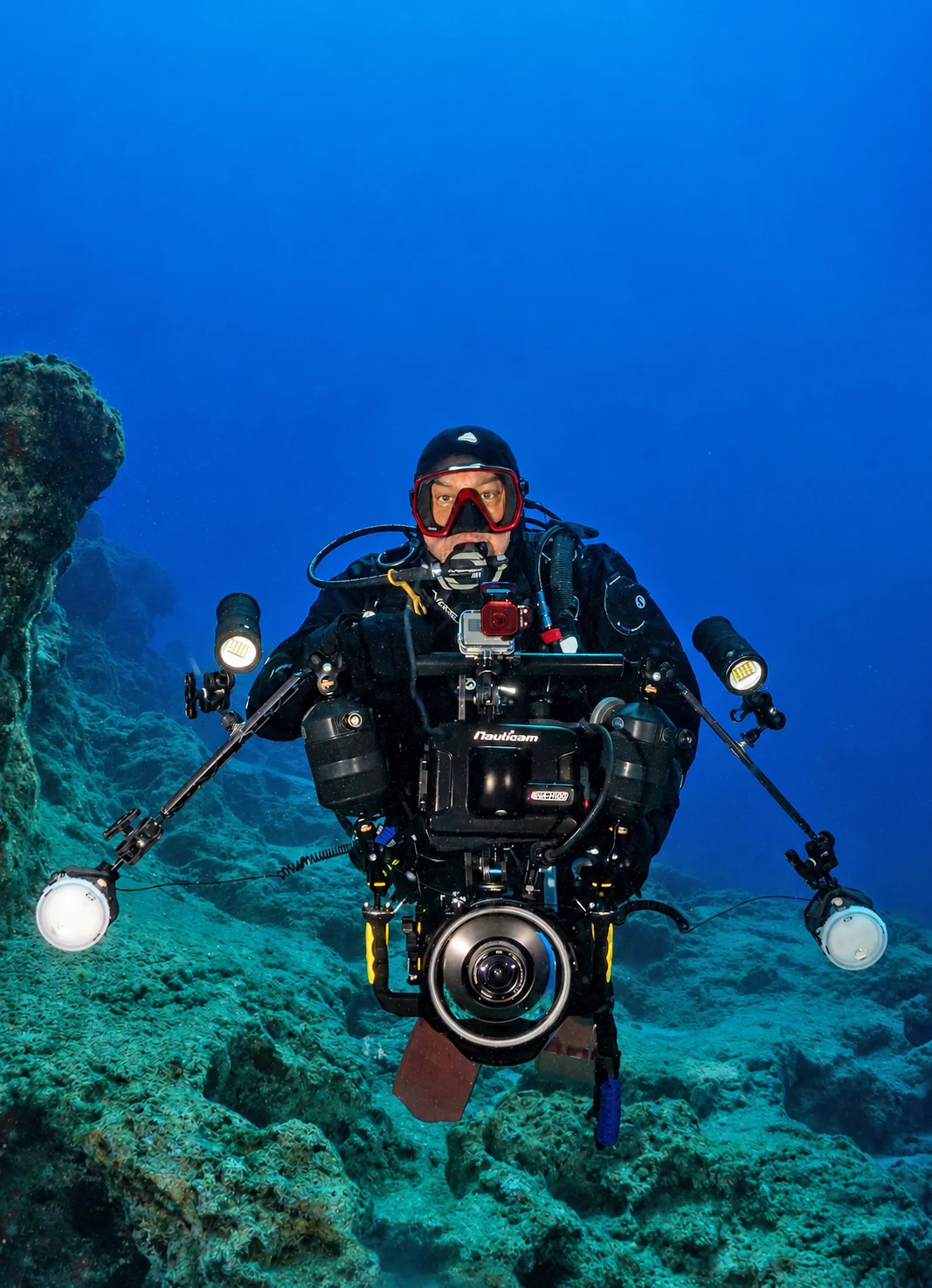
Text and photographs: Tahsin Ceylan
From the Naviga archive. The text reflects the account and observations of the period in which it was first published.
Sharks are among the rare species in our world that have managed to resist the transforming and destroying force of evolution and reach the present day. That alone earns them great respect. In the 1970s the silver screen introduced the whole world to Jaws, who knew no boundaries at sea. Over the following thirty to forty years, sharks were slaughtered until their population had fallen to a third. Those who killed sharks were presented as national, even international, heroes. Today they are at least legally protected throughout the world. The sharks of the Red Sea came to the world's attention in 2010 with the deaths of seven tourists.
In the immediate aftermath, hundreds of sharks were killed without anyone investigating the cause. National Geographic teams, wanting to put a stop to this, carried out research. It soon emerged that sheep imported from China on the eve of the Feast of the Sacrifice were behind the attacks: the shipping company had been throwing dead sheep into the sea, setting the stage for them. Scientists stress that we must not interfere with the natural world in any way. In the Red Sea, the region where you can see sharks is the southern route, reaching almost as far as the Sudanese border. We began our dives, guided by SCUBA-BAY's Yalın, at the Rocky Islands.
Divers and underwater photographers go in at first light, so to speak, in the hope of seeing sharks. Daedalus Reef (known as Abu el-Kizan) is the single most important dive site for seeing great hammerheads (Sphyrna mokarran) in numbers. Sphyrna means hammer in Latin. Daedalus Reef is an underwater mountain close to Marsa Alam, only a small part of which breaks the surface. At low tide the top of the reef is entirely visible. Measuring 400 by 100 metres, its slopes descend into the depths and are home to thousands of marine creatures.
A 30-metre lighthouse built in 1863 stands on it; it was renovated in 1931 and took its present form. Egyptian coast guard teams keep permanent watch here. A photograph of the lighthouse at sunset is a favourite shot among divers. The part of the reef nearest the lighthouse holds an underwater plateau. Starting at the shore and descending to 70 metres, the plateau then breaks away and continues deeper. Alongside the corals you can see many pelagic fish on the plateau dive, such as Napoleon wrasse and barracuda. But the world knows Daedalus for its hammerheads.
Great hammerheads usually travel in schools and live at average depths of 80 to 100 metres. Growing up to 6 metres, they reproduce by internal fertilisation and, after an eight-month pregnancy, give birth to between 6 and 40 pups — the number determined by the size of the mother. Schools are generally led by females. It is estimated that eight or nine species are known. The species appears on the conservation list of the International Union for Conservation of Nature (IUCN). Although we have very occasionally come across them close to the surface, we had our best chance of filming great hammerheads by waiting at around 40 metres. As a team we descended and took up our watch at 30 metres.
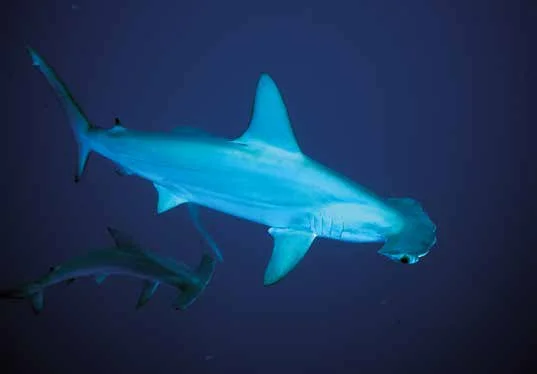
Our guide and the whole team waited in a circle in open water. Because our time at this depth is limited, you can sometimes be forced to surface without an encounter. In recent years, though, our chances have been better. After lingering around us for a few minutes with curious eyes, they descended into the depths. At our guide's grunt we all turned towards the same spot. Although at times they came very close, they rarely approached nearer than a metre or two. We began our ascent with a quiet smile on our faces. We made our safety stop at 5 metres and, because there was heavy boat traffic at the surface, we sent up our buoy.
Once the boat that would carry us to the main vessel had reached our buoy, we surfaced slowly and safely. Following these rules matters enormously. If you do not ascend under buoy control, the likelihood of an accident is very high. At the exact point of our exit we were seen off by two manta rays. At the last moment I managed to turn my lens towards them and take a few frames. At the end of a day on Daedalus Reef we set off for our next shark site, a gentle happiness on our faces. After an eight-hour voyage, our boat moored at the reef at midnight.
Elphinstone Reef
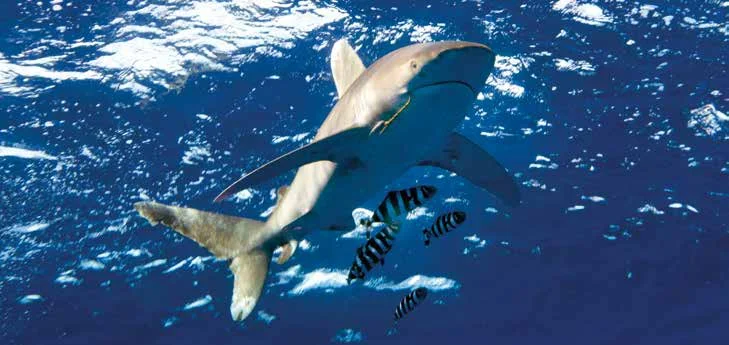
It would be no exaggeration to call this a small paradise underwater. Its upper reaches hold oceanic whitetip reef sharks (Carcharhinus longimanus), its depths are carpeted in corals of every colour. The species takes the name longimanus from its long pectoral fins; it means "long hands" in Latin. In such a confined space we genuinely did not know where to look first. Paradise for those who care, terrifying for those who do not. C. longimanus was the species everyone talked about in 2010; although the trigger was again human, it was held responsible for seven deaths. Averaging 3 to 4 metres in length, the reef shark reaches sexual maturity at around 2 metres.
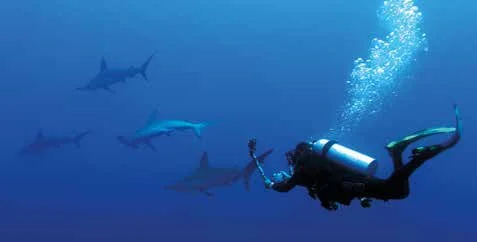
It is a viviparous species with a gestation period of one year. Its status on the conservation list of the International Union for Conservation of Nature (IUCN) was once "lower risk", then "threatened", and today it is listed as "critically endangered". Along with other shark species, the country where it is best protected is New Zealand. Heavy fishing pressure caused a very rapid decline — around 70 per cent — in its population. Its large fins made it a preferred catch: those fins were turned into soup for an insatiable humankind. Despite its place on the IUCN list, poaching cannot be stopped.
The first reef shark I ever came across underwater bore the marks of humankind. It had snapped the fishing line, but the hook it could not shake was still caught in its mouth. Every time it circled me it showed me that hook, as if to say: this is your doing. I thought of the lines of the poet Ahmed Arif: "As one shows a wound to a friend." Homo sapiens, the serial killer of ecology, believes itself the master of the entire universe — sadly. The shark moving through the shallower parts of the reef may be solitary, or it may suddenly become a school that surrounds you.
Because you will drift seaward with the current while trying to film it, someone must certainly be looking after your safety. At the very least, one eye should be on you. When filming this species it is strongly advised that an expert be with you and that you yourself have sufficient knowledge of and experience with the animal's behaviour. Reef sharks show no timidity at all towards divers. One came and passed over me close enough to graze my head. Showing panic or provocative behaviour is extremely risky. You must stay calm, and keep staying calm. You will always see small pilot fish riding along with them, and from time to time you may come across a remora.