The Clever Arms of the Sea: Octopuses
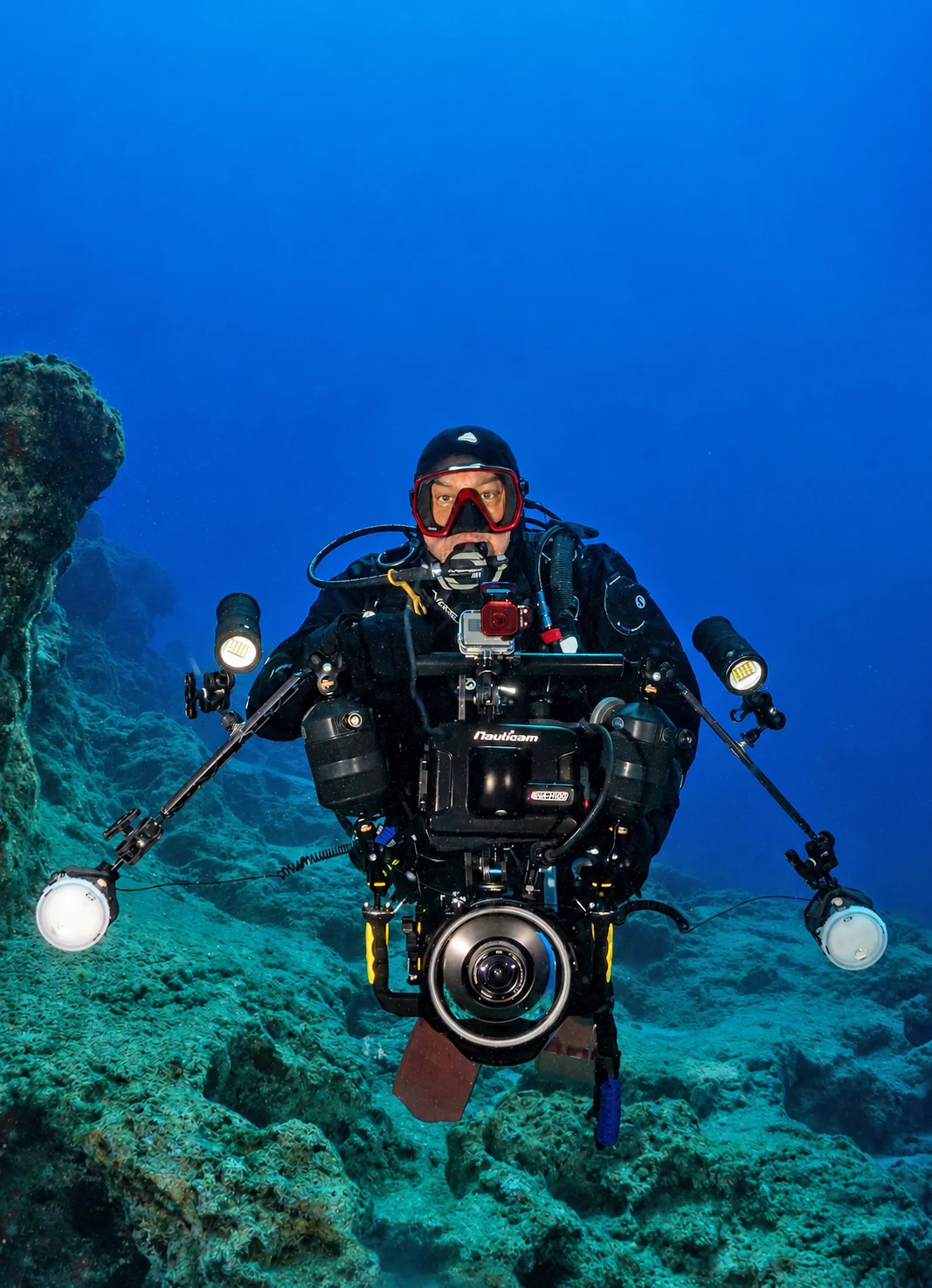
Text and photographs: Tahsin Ceylan
From the Coast Guard Magazine archive, December 2009. The text reflects the account and observations of the period in which it was first published.
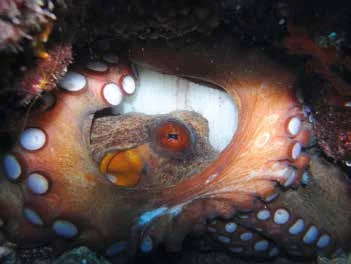
"Each of its eight arms seems to carry a meaning. The first four speak of loyalty, protection, love and tenderness — for its mate and for the young waiting to join the natural world. Of the remaining arms, one stands for the will to survive and another for its dominion in the deep blue. The last two arms are for us." This is how Tahsin Ceylan, who carries the sea frame by frame from the depths onto white pages, describes the octopus: the most intelligent invertebrate of the blue, which some call a "monster". Noting how resilient and patient octopuses are, Ceylan lays bare many of the qualities of these creatures as they pose before his lens.
Here, then, are octopuses, told like a documentary. They are creatures resilient enough to live for forty-eight hours on land, skilled enough to vanish in an instant, tough enough to pass through a fire without feeling a thing, and strong-armed enough to hold a loved one tight in the soul of the sea. In this piece we will try to get to know the sea's eight-armed, most intelligent creature — one that has found its way into our viewing, our reading and our visual life, and about which we all carry some intuition, right or wrong. Zoologists point to them as the only animals among invertebrates with a complex brain structure.
They can later identify a place where their life was in danger and manage to keep away from it. They slip expertly through narrow spaces. An arm torn off, or taken by a predator in an attack, can grow back. Biologically members of the mollusc family, octopuses belong to the cephalopod group. With around 300 species, octopuses range from forms reaching 10 metres in length and 200 to 300 kilograms in weight down to species only a few centimetres across. As in every creature, the instinct for self-protection is found in octopuses too.
Entirely harmless to humans, these animals use their powerful arms for hunting and for defence. Their highly developed sense of vision, one of the defining traits of an active predator, is comparable to that of vertebrates. The powerful, suckered arms emerging from the head region, whose length varies between species, were described by the great writer Victor Hugo in his novel Les Travailleurs de la Mer (Toilers of the Sea) as elastic as leather, hard as steel and cold as night.
What is on an octopus's menu?
Each arm of an octopus carries around 240 suckers, arranged in a single or double row. They are animals patient enough to change colour into perfect harmony with their hiding place and to wait motionless for hours for their prey. On their menu, octopuses prefer crustaceans — crabs above all, along with lobster and mussels. Because they throw the remains of the evening's feast straight out of their den, it is quite easy to spot their burrows on sandy ground.
More often than not an octopus does not break the shell of the crab it has caught; with its slender arms it tears off the edible parts and leaves an empty shell behind. Many observers agree on the patience octopuses show when hunting. One observer's account on this subject leaves you in awe of their intelligence. As you know, shellfish such as mussels have very powerful muscles, so a great deal of effort is needed to prise their shells apart.
It is said that an octopus, reckoning this would cost too much energy and time, will sometimes lie motionless in ambush near its prey and, the moment the mussel parts its shell, throw a stone between the valves to stop the shell closing again. Although they occasionally hunt by day, octopuses are generally active at night. For prey with stronger defences, the octopus brings two deadly weapons into play: the beak at the very centre of its mouth cavity, and the venom it can secrete. The beak is hard and sharp enough to break shells.
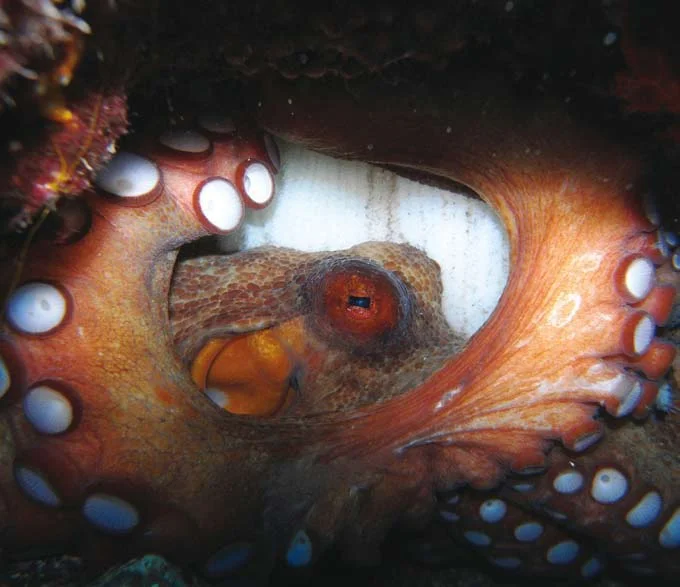
In Twenty Thousand Leagues Under the Sea, Jules Verne writes: "The only hard part of the octopus is its scissor-shaped mouth, sharp as a parrot's beak, which it generally uses to break open the shells of its prey. It also has a rasp-like tongue that serves to bore through the shells of shellfish and tear out the flesh inside." The venom secreted from its salivary glands affects the prey's nervous system and can cause it to tremble and die within a short time.
A smokescreen of ink
With its high nutritional value, the octopus has always had predators. It turns out that an octopus's most effective weapon against its enemies is not so much its powers of camouflage as the ink (sepia) secreted by glands between its gills. The celebrated marine scientist Jacques-Yves Cousteau, who often had the chance to observe this defence mechanism in cephalopods during his underwater explorations, wrote in his notebook: "I believe that squirting ink is a smokescreen that hides the octopus from the predator pursuing it.
Because the secretion does not disperse in the water; it hangs there like a shadow with a tail, a silhouette small enough to conceal the octopus. The shape and size of this silhouette are roughly the same as those of the octopus that released it." For a predator chasing prey that constantly changes colour, it must be quite startling to see a pitch-black object appear from nowhere and resemble the thing it was chasing. That brief moment of surprise can be long enough to save the life of an octopus that suddenly changes direction and colour and becomes all but invisible. The ink is also strong enough to paralyse for hours the sense of smell of the moray eel, the octopus's greatest enemy.
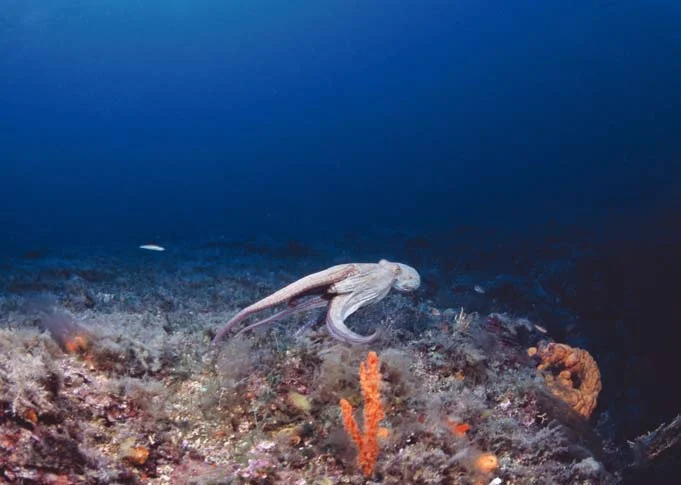
The ink that gives the octopus such an advantage is at the same time a weapon dangerous enough to bring about its own end. The predator on its tail is not the only thing the octopus is fleeing after releasing its ink: if it stays within the cloud it has made for a few minutes, it can be poisoned and die. Despite having no skeleton, the octopus has in recent years been recorded by scientists as effectively walking on two arms while escaping its enemies.
As long as it has not taken a serious blow to its central nervous system, it has the ability to regenerate severed or injured limbs; and like other cephalopods, octopuses move by drawing water into the body and expelling it under pressure. Because of the powerful thrust of water, this movement is also called "jet propulsion". Octopuses cannot move as fast as their cuttlefish relatives, however, and their average speed is no more than eight miles per hour. As for measures of resilience: wrapped in wet cloths, an octopus can survive on land for 48 hours.
The sorrowful end of the mother octopus
As in other cephalopods, one or several of an octopus's arms are modified to serve as a reproductive organ. The purpose of this structure is to deliver sperm cells into or near the female. The shy male blushes and changes colour when he touches the female — much as a person's face reddens in similar circumstances. They mate only once in their lives. The female arranges the fertilised eggs in clusters. The length and number of these clusters are closely related to the octopus's age and condition: a young octopus may form 12 to 30 clusters, while in a mature individual the number can reach 50.
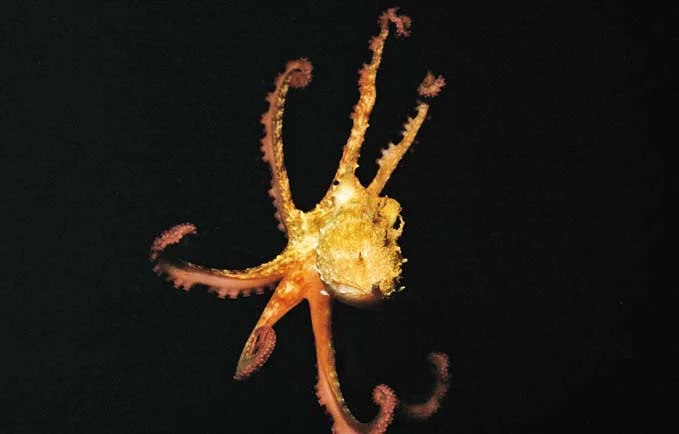
Of the 150 to 200 eggs in each cluster, only a few will ever become adult octopuses. For the female, the eggs come first: with the thin membranes on her arms she holds them gently and takes care to keep them clean. Creating a current with her siphon, she supplies her young with oxygen. The sense of motherhood, and the self-sacrifice it brings, is different and far greater in octopuses. Once she has laid her eggs, the female stops eating and waits five months for her young to hatch. At the end of this extraordinary devotion, as her young say hello to life, she bids it farewell.
The most intelligent invertebrate
Octopuses — whose Hawaiian name means "gliding ghost" — may not be the giants we see in Hollywood films, wrapping their arms around enormous ships and swallowing them whole, but they do have the most advanced nervous system in the cephalopod family. Most marine scientists describe the octopus as the most intelligent invertebrate on earth. Some even consider their intelligence equal to that of a domestic cat. Each of its eight arms carries a meaning: the first four seem to speak of loyalty, protection, love and tenderness, for its mate and for the young waiting to join the natural world. Of the remaining arms, one stands for the will to survive and another for its dominion in the deep blue.
And the last two arms are for us, as if to say: come, hold me. Portrayed differently in various novels and films, the octopus is not a "monster" but quite the opposite — the warmest-blooded creature of the seas. Describing the octopus, the marine scientist Neil McDaniel says: "…there is a look full of meaning in their eyes, as if to say I see you very well, and I know you!" Although it has not yet joined the list of endangered species, in Türkiye it continues to live under serious fishing pressure.
From Keldağ to Saros, on every dive, greetings from the soul of the sea to the octopus — timid yet waiting to be noticed, as if to say "see me"; accompanying us with its warm gaze and posing for our lens.
SOURCES:
Sualtı Dünyası, February 1997, Özen Can. Ceylan Tahsin, Sekiz Kollu Güç ve Zekâ Timsali http://sizinti.com.tr/yazdir.sizinti?SIN=50c9966508&k=2805&626523994 "Intelligenz Bestien; Riesenkraken sind keine Monster", Stefan Raps, Natur, September 1996. "Die schwebende Kindheit des Octopus", Jean Lecomte, Geo, January 1996. "Rendezvous mit einem intelligenten Monster", Neil McDaniel, PM, June 1995. http://www.iwf.gudg.de/iwfger/alldaten/c669.html