Invasive Species in Our Seas
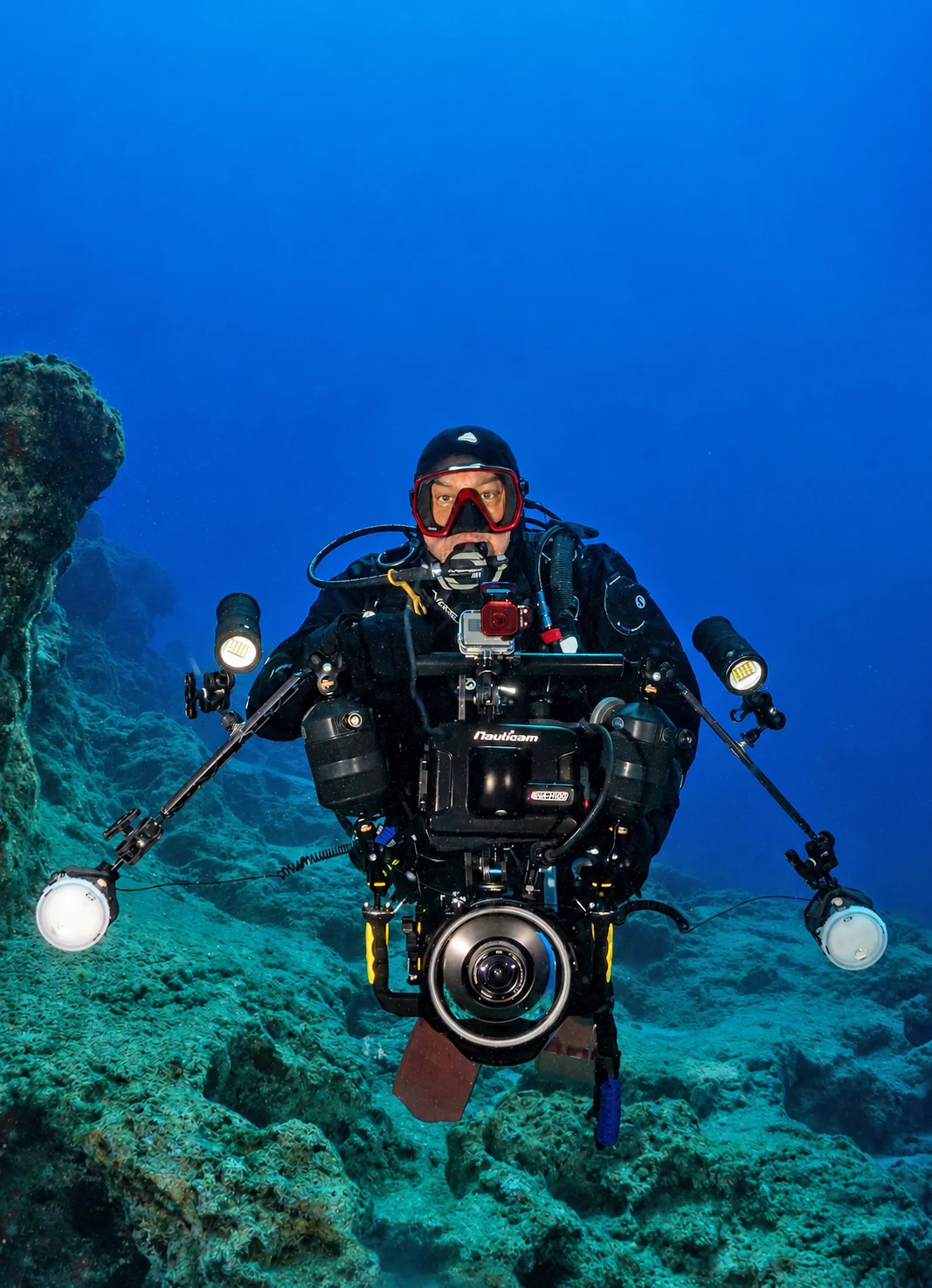
Text and photographs: Tahsin Ceylan
From the Naviga archive. The text reflects the account and observations of the period in which it was first published.
There is scarcely a sea on this planet that does not affect another, that does not feed another with life. Narrow water corridors open, sometimes by natural means and sometimes by human hand, and a passage forms between two foreign water worlds. A flow of life in both directions follows, slow at first but then gathering pace. As exotic species occupy natural communities, native species unable to cope with their spread disappear.
The opening of the Suez Canal in 1869 joined two entirely different zoogeographic regions — the subtropical Mediterranean and the tropical Red Sea — and so set off the migration of all manner of organisms: algae, flowering sea plants, planktonic creatures, sponges, annelid worms, molluscs, arthropods, tunicates, fish and more. The tropical world of the Red Sea has been mingling with the Mediterranean for more than 200 years. The Mediterranean is rapidly becoming tropical, and the number of species rises with each passing day.
In a sense, humankind is unwittingly responsible for the migration of a great many marine species away from their natural habitats. At the same time, the effects of global climate change on the Mediterranean are relatively keenly felt. Rising heat and the evaporation that comes with it have made the Mediterranean one of the saltiest seas in the world. With the deepening of the Suez Canal between the Mediterranean and the Red Sea, and the opening of a second channel alongside it, the entry of invasive species into the Mediterranean has accelerated. Species spreading through the Suez Canal can now be seen along our Aegean coasts as well.
The number of species that have crossed into the Mediterranean is said to have passed 500 to 600 by now. The lionfish, one of the ecosystem's predators, has begun to establish a population along our coasts. Although this change in the ecosystem puts pressure on native Mediterranean species, it also draws keen interest from underwater photographers and documentary makers — not least because scientists are in a race to record new species identifications. The great majority of Red Sea species that have crossed into the Mediterranean have a wide distribution across the Indo-Pacific, which shows how easily they adapt to very different environments.
Mediterranean ecology, poor in nutrients and therefore home to relatively few species, rests on very delicate balances. These incoming species, thanks to their capacity to adapt, gain the upper hand over local species, and population explosions follow in a very short time. To date there is no evidence that any Red Sea species has wiped out a Mediterranean one. But when the composition of commercially fished species in the Eastern Mediterranean is examined year by year, species of Red Sea origin are seen to become a little more dominant each year.
These data suggest that, over the very long term, foreign invasion could change the structure of the Mediterranean ecosystem entirely.
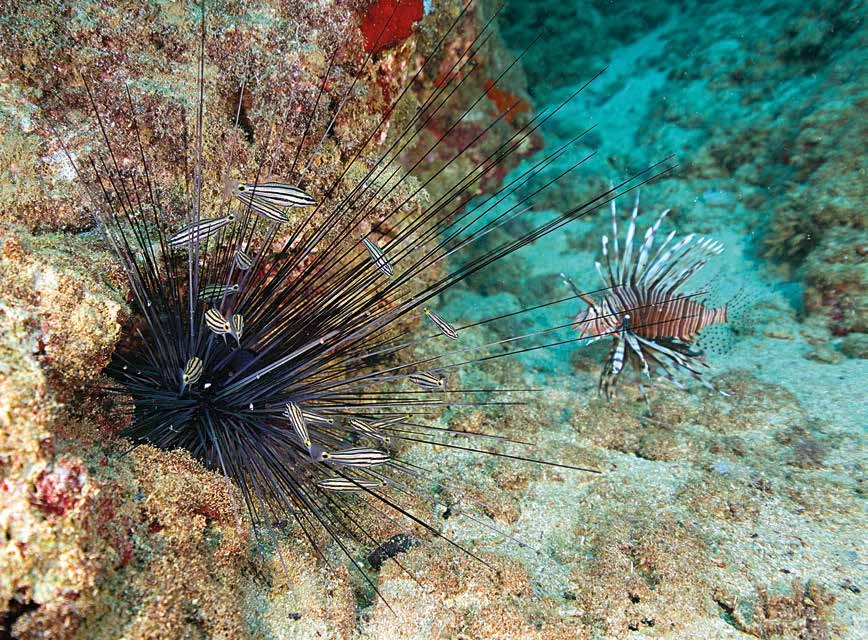
Lionfish (Pterois volitans)
Found in almost every sea in the world, the lionfish is one of the venomous reef fish that have crossed into the Mediterranean through the Suez Canal. In the Indian and Pacific Oceans it has predators, so its population is kept in check and it exerts no widespread pressure on other species. Off the southeastern coasts of the United States and in the Caribbean, where it has few predators, it has become an invasive species exerting heavy pressure on others. Given its capacity to adapt, the situation in the Mediterranean is no different.
In the Caribbean, special fishing techniques were developed to reduce its numbers and divers carried out operations, but these were abandoned as they produced no result: the stretch of sea divers can enter and observe is incomparably small next to the area over which the species has spread. Carnivorous, the lionfish feeds on the young of all fish, so the harm it does to the ecosystem is considerable. It does not appear possible for humankind to prevent it. Not touching them is the most important precaution against the risks they pose.
Bluespotted cornetfish (Fistularia commersonii)
Widespread in the tropical and subtropical waters of the Indo-Pacific. The species crossed into the Mediterranean in 2000 and has no commercial value. Thanks to its success at adapting, it spreads rapidly. A favourite of underwater photographers, the cornetfish often finds its way into our frame at night in the pelagic zone. In the Indo-Pacific it is known to be used as fish bait.
Rabbitfish (Siganus luridus, Siganus rivulatus)
Members of the Siganidae family native to the western Indian Ocean as well as the Red Sea and the Persian Gulf, rabbitfish spread into the Mediterranean through the Suez Canal. They are often found over compacted sand and in small hollows in shallow water, feeding on benthic algae. The spines in the dorsal and anal fins carry venom that is not life-threatening to humans. Their commercial value in the Mediterranean is rising fast.
Pufferfish (Torquigener flavimaculosus, Lagocephalus sceleratus)
T. flavimaculosus is known as the yellowspotted puffer. Its native range is the northwest Pacific and Japan. In Japan the species, called "fugu", is served as a dish prepared by master chefs. It is famous for the works of art it makes by shaping the sand underwater to impress the female. Living in the benthic zone, its population in the Mediterranean is rising rapidly. L. sceleratus, with its silvery cheeks, is widespread in the tropical waters of the Indian and Pacific Oceans. It carries tetrodotoxin in all its organs and is extremely poisonous. TTX is a marine toxin 1,200 times stronger than cyanide and 3,000 times stronger than morphine.
This deadly substance causes its victims to stop breathing or triggers heart failure. Deaths following consumption have been reported in Egypt, Israel and Lebanon.
Red Sea goatfish (Parupeneus forsskali)
Widespread in the Indian Ocean, the Red Sea and the Gulf of Aden, the species crossed into the Mediterranean through the Suez Canal. Spreading rapidly in the Eastern Mediterranean, it has quite a high commercial value.
Veined rapa whelk (Rapana venosa)
The rapa whelk, which has considerable commercial value in Türkiye, was first seen in 1947 in the Bay of Novorossiysk, a port city in the Commonwealth of Independent States. First recorded on the Turkish coast off Trabzon in 1962, the invasive species is thought to have been carried in the ballast water of ships arriving from the Sea of Japan. The rapa whelk feeds on mussels, oysters and other molluscs. With no predator in the Black Sea, its growing numbers have reduced mussel and oyster stocks, which in turn affects the feeding environment of fish.
Regarded as a pest until recent years, this invader has today become a valuable product: it offers our fishermen an alternative catch, creates employment and added value through the processing plants that have been built, and, although there is no domestic consumption, brings in significant foreign currency through export. Because rapa whelks are voracious and have no balancing natural rivals or predators in the Black Sea and the other seas into which they continue to spread, they reproduce and spread rapidly, and should be fished and kept under control at a rate matching their recruitment to the stock.
Comb jelly (Mnemiopsis leidyi)
Another major invasive species, one that has created a widespread habitat in the Black Sea and effectively overrun it, is the comb jelly Mnemiopsis leidyi, carried there in the ballast water of cargo ships from the eastern United States in the early 1980s. Carnivorous, and although called a jellyfish, Mnemiopsis leidyi in fact belongs to the comb jellies (Ctenophora), a group distinct from true jellyfish. Reaching at most 100 to 120 millimetres, it feeds on zooplankton, fish eggs and larvae. In a single day it can consume ten times its own body weight.
The greatest factor behind this species' invasiveness is that an animal hatching from an egg reaches maturity within two weeks and lays 8,000 eggs a day (Kıdeyş). Through this rapid reproduction it reached an enormous population of some 800 million tonnes and was seen to all but destroy Black Sea fisheries in the 1990s. The invasive comb jelly affects fish species in three ways. Mnemiopsis prevents fish from reproducing by feeding on their eggs and larvae. It also competes for food by feeding on zooplankton, the staple diet of carnivorous fish and fish larvae.
As the rapidly multiplying M. leidyi die, they begin to accumulate on the seabed, worsening a pollution problem that is already serious; and that pollution means habitat loss for many fish species. Fish are foremost among the species most affected by Mnemiopsis. Combined with the adverse ecological conditions in the Black Sea, this invasion caused first a reduction in fish size from the 1980s onwards, owing to the shortage of zooplankton, and in later years a significant decline in stocks.
According to FAO data, from the late 1970s to the mid-1980s the average catch of small pelagic fish (anchovy and sprat in particular) was 520,000 tonnes, making up 76 per cent of the total. In the late 1980s and early 1990s, anchovy and sprat stocks fell threefold, both because of pollution and because the invasive Mnemiopsis leidyi consumed the diversity of food in the Black Sea.
Seagrass (Halophila stipulacea)
Native to the Indian Ocean, the species crossed into the Mediterranean through the Suez Canal. Its rate of spread is astonishing. Invasive in the Mediterranean and the Caribbean, it has a high capacity to adapt to different environmental conditions and can grow quickly. Although it has been recorded deeper than 50 metres, its most common range is 0 to 30 metres.
Sea urchin (Diadema setosum)
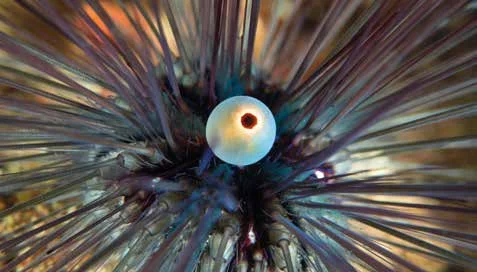
The long-spined sea urchin Diadema setosum is one of the most widespread sea urchins in the tropical Indo-Pacific, particularly in coral ecosystems. Its ecological role is considerable. It can be found from the Red Sea to Hawaii and the Pacific archipelagos, from the shore down to 20 to 30 metres and sometimes deeper. The most distinctive feature of D. setosum is an orange ring around the anal papilla, though in some specimens this is less visible. Five white spots also serve to identify the species. Some of its shorter spines are venomous, as in most diadematids, but not genuinely dangerous.
It entered our records on the Turkish coast, home in turn to cardinalfish and shrimp that are themselves invasive.
Ragged sea hare (Bursatella leachii)
Native to the Indian and western Pacific Oceans. The green-brown Bursatella leachii has a broad, short head. It lives in estuaries, in the intertidal zone and on sandy bottoms. It moves slowly on a broad foot. The species has a short tail, and it is usually possible to see two individuals together. Only with the right use of light can you see the colours on its body. Its population increases in the benthic zone are quite rapid.
Nomad jellyfish (Rhopilema nomadica)
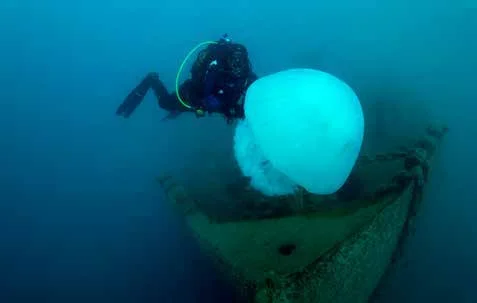
A jellyfish native to the warm tropical waters of the Indian and Pacific Oceans. It is thought to have entered the Mediterranean through the Suez Canal in the 1970s. It has been recorded in the Eastern Mediterranean, off the coast of Israel, and in the Aegean along the Turkish and Greek coasts. It was seen on the Turkish coast of the Eastern Mediterranean in 1995. R. nomadica has a pale blue body and a rounded bell. It can grow to 10 kilograms, and the bell is generally 40 to 60 centimetres across, though it can reach 90. It is eaten by fish and turtles. It is capable of both sexual and asexual reproduction.
The European Union lists it among the worst invasive marine species in European waters. When I filmed it at Antalya Marina I could not believe its size: my diving companion Murat Kulakaç disappeared behind it.
Redcoat soldierfish (Sargocentron rubrum)
Native to the Pacific and Indian Oceans, the species is found in many seas around the world. It crossed into the Mediterranean through the Suez Canal. Although it has no commercial value as yet, it is caught by fishermen. Its striking colours make it a favourite of underwater photographers.
Vanikoro sweeper (Pempheris vanicolensis)
Native to the Indo-West Pacific, the species crossed into the Mediterranean through the Suez Canal. Although it is seen in surface waters in the Red Sea, in the Mediterranean it generally chooses sheltered, dark places. It has no commercial value. As humanity moves about ever more, the rate at which various creatures pass from one ecosystem to another has risen radically. As exotic species occupy natural communities, native species unable to cope with their spread disappear. Exotic species threaten global biological diversity and are increasingly becoming an economic burden.
Sources
Karadeniz'de istilacı türler (Dr. Gülnur Özdemir, Binnur Ceylan-Sumae) Biyolojik İstila (Chris Bright, Worldwatch Institute)